
Emergency Roof Repair Near Me: What Garden Grove Homeowners Should Do First
If water is coming through your ceiling in Garden Grove, your first job is to control the interior spread, not to fix the roof itself. Move valuables and electronics out of the room, place a bucket under the drip, and if you see the ceiling drywall sagging or bowing downward, get everyone out of that room immediately and call a roofing contractor. A sagging ceiling holds a surprising amount of water weight and can collapse faster than most people expect. If you’d rather skip the guesswork entirely, call Crown Line Roof Repair at (844) 966-3891 and we’ll walk you through what to do before we arrive.
Putting a bucket under an active drip is fine. Cutting a relief hole in your ceiling to “let the water out” is something we see homeowners do during Garden Grove’s brief heavy rain events, and it turns a $400 repair into a $2,800 drywall and insulation job. Don’t do it. The water needs a controlled path, not a bigger exit.
Step One: The 90-Minute Interior Triage
The first 90 minutes after a roof breach in Garden Grove determine how far the damage spreads. Water follows the path of least resistance, and in a typical Southern California attic with blown-in insulation and drywall ceilings, that path moves horizontally before it shows up vertically. You may see a stain in one corner of the living room while the actual penetration point sits fifteen feet away near the ridge line.
Here is the interior sequence we recommend, in order:
- Locate every drip point. Count them. A single visible drip does not mean a single breach. Water often enters one spot and exits through three.
- Move furniture and electronics at least six feet from any staining, not just from the active drip. The stain is a map of where water is traveling inside the ceiling cavity.
- Press gently on stained drywall with a broom handle. If it gives, feels spongy, or leaves a dimple, the drywall is saturated. This is the area to monitor.
- Check for sagging. Any visible bowing, cracking along seams, or change in ceiling contour means water is pooling. Evacuate the room and do not stand under it.
- Take photos before you touch anything. Adjusters want the before state, not the after-cleanup state.
Here is the thing most Garden Grove homeowners get wrong: cosmetic staining and structural saturation look similar for the first few hours. A water ring on the ceiling is cosmetic. A ceiling that feels like a wet sponge is structural. If you are unsure which one you are dealing with, stay out of the room and call us. We’ll tell you over the phone whether it can wait until morning or whether you need to shut things down now.
One more note specific to Garden Grove. Many homes here were built in the 1960s and 1970s with gypsum board ceilings and minimal attic ventilation. Older drywall absorbs more water before it fails, which means the warning signs last longer but the eventual collapse is heavier. A newer home fails faster with less warning. Age changes the triage math.
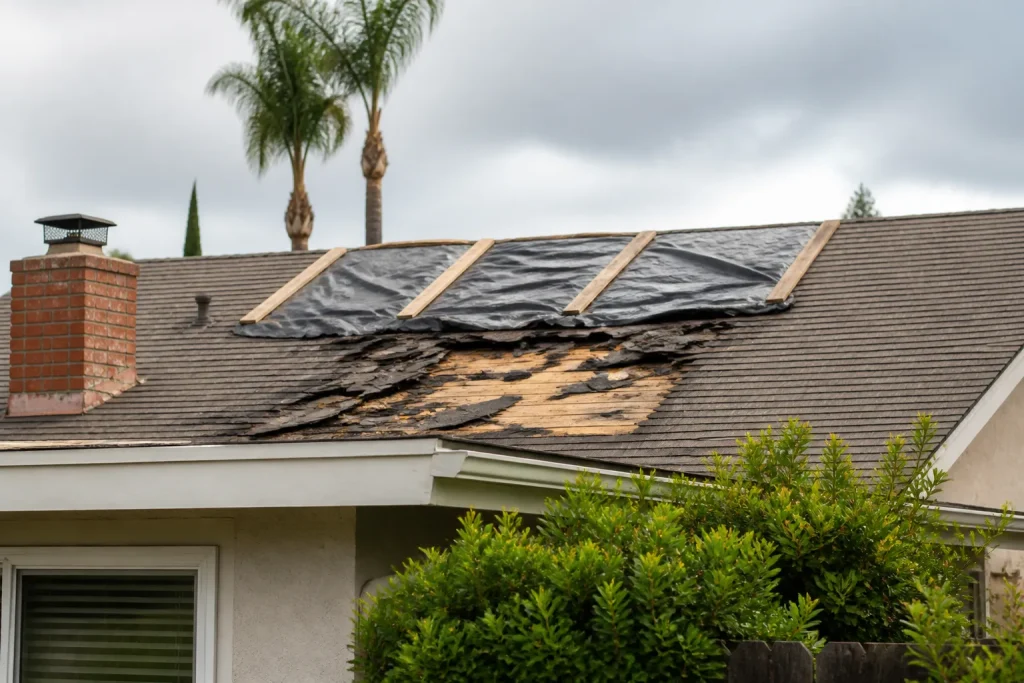
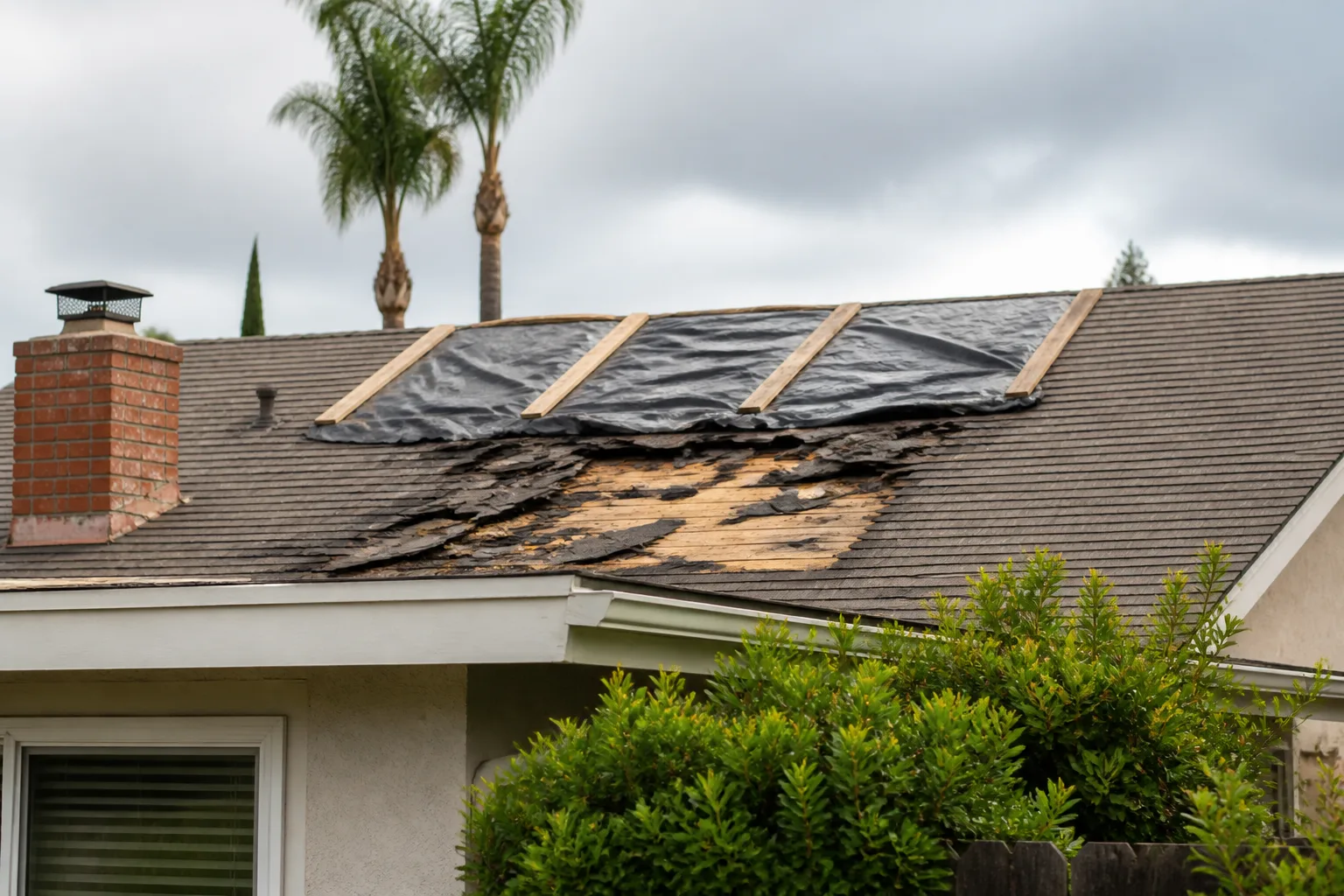
Step Two: Temporary Tarping That Actually Survives Santa Ana Winds
If you decide to tarp the roof yourself before a contractor arrives, understand what a weekend hardware store tarp can and cannot do. Most blue polyethylene tarps sold at big-box stores are 5 to 6 mil thick. That is fine for covering a patio table. It is not fine for a Garden Grove roof in a Santa Ana event, where wind gusts routinely hit 40 to 50 miles per hour and need to be resisted over a span of days, not hours.
Effective temporary tarping requires three things:
- Weight. A 10-mil or heavier tarp. Lighter material shreds at the grommets under wind load.
- Overlap. The tarp must extend at least four feet past the damaged area on all sides, including up and over the ridge line if the breach is within three feet of the peak. Water travels uphill in wind-driven rain.
- Anchor points. You cannot nail into the roof deck without creating new leak points. The correct method is to sandwich the tarp between furring strips screwed into the roof, then seal the screw heads. If you don’t have furring strips and roofing screws, don’t improvise.
We have pulled more than a few “temporary” tarps out of Garden Grove gutters and off neighbor’s cars after a windy night. A tarp that comes loose mid-storm is worse than no tarp at all. It becomes a sail that tears off more shingles on its way out. If you are not set up to anchor a tarp properly, skip the tarp and focus your effort on protecting the interior until we can get eyes on the roof.
When we arrive, we’ll assess whether a temporary tarp is even the right call. In many cases on shingle roofs, a direct spot repair is faster and cheaper than tarping labor that you will pay to undo later. Our repair-first approach means we fix what is fixable before recommending anything bigger. That is the whole reason the company is called Crown Line Roof Repair, not Crown Line Roof Replacement.
Step Three: Document for the Insurance Claim Before Any Temporary Repairs
Insurance adjusters look for specific things, and the photos you take in the first hour matter more than anything you photograph after cleanup. Here is what we tell Garden Grove homeowners to capture:
- Wide shots of every room showing the context of the damage, not just close-ups of the stain.
- Close-ups of the ceiling stain or drip with a ruler or common object for scale. A coffee mug works. A quarter is too small.
- Photos of the exterior roof from at least two angles, including the section directly above the interior damage.
- Photos of the attic from the access point if you have one. Do not walk the attic floor. Photos from the ladder are enough.
- Screenshots of the weather event with date and time stamps. Garden Grove rain events are brief and intense, and an adjuster reviewing your claim three weeks later may not remember the specific storm.
Timestamps matter. Most phone cameras embed them automatically, but verify the setting before you start snapping. An adjuster who sees a time-dated sequence from first drip to final cleanup can process a claim faster than one who sees a folder of undated photos with no narrative.
Do not begin any permanent repair work until your insurance company has confirmed the damage and scheduled their assessment, unless the damage is actively worsening and a delay creates more liability. Temporary mitigation, like tarping and interior water control, is fine and expected. Ripping out wet drywall before an adjuster photographs it is a good way to have the claim denied or reduced.
If you are unsure how your specific policy handles roof repairs in Garden Grove, our roof inspection service includes documentation that helps you understand what you are looking at before the adjuster shows up. You don’t need to commit to a repair or replacement. You just need an honest read on the roof’s condition.
Step Four: The Three Questions That Separate a Real Roofing Contractor from a Storm Chaser
After any significant weather event in Garden Grove, out-of-town crews arrive within 48 hours. Some are excellent. Some are not. The difference is not always visible at the door, because they all show up with trucks, ladders, and printed estimates. The difference comes out in the phone call.
Here are the three questions to ask any contractor before they touch your roof:
- “Where is your actual office?” A real local contractor has an address you can visit, not a P.O. box in another county. Storm chasers use call centers and hotlines that ring to dispatchers in another state. Ask for the physical address and say you’ll stop by with a check. Watch the reaction.
- “Which shingle manufacturers do you work with?” A knowledgeable contractor can name the brands they are certified on and explain why one is appropriate for your roof and another is not. We work across seven major manufacturers: GAF, CertainTeed, Owens Corning, IKO, Atlas, Tamko, and Boral. The point is not to impress you with a list. The point is that we can match whatever is already on your roof instead of pushing whatever product we happen to have in the warehouse. A storm chaser with one brand in the truck will sell you that one brand.
- “Will you provide a written scope of work before starting?” If the answer is anything other than yes, end the call. A contractor who cannot describe exactly what they will do, what materials they will use, and what the finished condition will be is not operating as a roofing specialist. They are operating as a door knocker with a truck.
Storm chasers also tend to pressure you with expediency: “We can start today, but the price goes up tomorrow.” Legitimate roof repair in Garden Grove rarely requires a split-second decision. We pulled one out of a garage over in the West Grove neighborhood last spring where a homeowner had agreed to a full replacement from an out-of-town crew after a minor leak at a pipe boot. Total repair cost: about $300 in materials and two hours of labor. The replacement quote he had signed was over $18,000. If the words “full replacement” come out of a contractor’s mouth before they have even been on the roof, that is the tell.
Step Five: When the City Is Involved, Not You
Some roof breaches in Garden Grove have nothing to do with your roof. If a street tree limb came down during a wind event and punctured your roof, or if a city-maintained tree dropped debris that caused the damage, the City of Garden Grove may bear liability. This changes the entire sequence.
Here is how to tell the difference:
- Street tree vs. private tree. If the tree sits between the sidewalk and the curb, it is almost certainly a city tree. If it sits in your yard, it is yours.
- Photo evidence of the limb or debris still on your roof or in your yard before you move it. Do not remove the evidence until the city has documented it or you have extensive photos with timestamps.
- A written claim filed with the City of Garden Grove Public Works department. They have a claims process, and it is slower than your insurance company’s process, so start both and let the two parties sort out reimbursement.
City infrastructure issues can also involve water runoff from streets or storm drains that backup into residential roofing. If you suspect the water came from a city source rather than rain falling directly on your roof, document it and call both the city and your insurer.
In either case, the immediate mitigation responsibility is still yours. You have a duty to prevent further damage regardless of who pays the final bill. That means interior triage, temporary protection where feasible, and getting a professional assessment from someone who does roof inspection as a standalone service in Garden Grove. No pressure to buy anything. Just a clear picture of what you are dealing with.
When to Call a Professional
You have done your 90-minute triage. You have documented the damage. You have a tarp up or you don’t. Now comes the question of whether to call someone or keep managing it yourself.
Call a roofing professional if any of these are true:
- The ceiling is sagging or showing wet cracks, even a little.
- The leak is near any electrical fixture, junction box, or wiring run.
- Water is entering through more than one ceiling location.
- You cannot identify the source from the attic or exterior.
- You have an active insurance claim and need a professional assessment to support it.
- The roof is over a single story and you would need to walk on it to assess anything. Walking a wet shingle roof is how homeowners end up in urgent care. Don’t.
For Garden Grove homeowners, the relevant related services are straightforward: Roof Repair in Rowland Heights covers the repair-first approach we take on every job, and Roof Inspection in Rowland Heights is the standalone service that gives you an honest professional read on your roof’s condition without any obligation attached. If the damage turns out to be extensive, Roof Replacement in Rowland Heights is there when the numbers actually justify it.
The Bottom Line
Emergency roof repair in Garden Grove comes down to controlled response, not speed. Protect the interior first. Document everything. Ask the right questions before any contractor climbs a ladder. And remember that a sagging ceiling is a structural warning, not a cosmetic one.
We work with your roof’s existing materials, not against them. That means matching shingle brands like CertainTeed, Owens Corning, or Atlas when a partial repair is the right call, and being honest with you when a full replacement makes more sense. Seven major brands. One honest recommendation.
If you’re in Garden Grove and need help with a roof that is actively leaking or showing signs of failure, Crown Line Roof Repair home has the full picture on what we do. We offer free estimates, and you can reach us at (844) 966-3891. No pressure. Just a straight answer about what your roof needs.
Frequently Asked Questions
Emergency roof repair in Garden Grove typically runs between $350 and $900 for minor leaks, pipe boot replacements, or small shingle patches. Larger breaches involving structural damage, decking replacement, or multiple shingle courses can push costs to $2,000 or more. The final number depends on what the water actually damaged, which is why we recommend a Roof Inspection in Rowland Heights before committing to a repair scope. Call (844) 966-3891 for an exact quote. Estimates are free.
If the drip is slow, the ceiling is not sagging, and you have a bucket catching water, waiting until morning is usually fine in Garden Grove’s dry climate. If the ceiling shows any bowing, the leak is near electrical fixtures, or water is entering faster than a bucket can handle it, do not wait. The structural risk compounds quickly. Call (844) 966-3891 and we’ll help you assess the situation over the phone.
Most homeowner policies in California cover sudden storm-related roof damage, but coverage depends on your policy’s age, deductible, and how the damage occurred. Gradual wear and tear is rarely covered. Document everything with timestamped photos before any temporary repairs begin, and file your claim promptly. If you need help understanding what you are looking at before an adjuster arrives, a standalone roof inspection gives you professional documentation to support your claim. Call (844) 966-3891 to schedule one.
A properly installed 10-mil tarp with furring strip anchors can hold through several weeks of Garden Grove weather, including moderate Santa Ana wind events. A lightweight hardware store tarp secured with nails or staples may not survive the first windy afternoon. If you are not equipped to anchor a tarp correctly, focus on interior protection and call a roofing contractor. We can apply temporary protection that actually stays put. Call (844) 966-3891 for help.
Written by the team at Crown Line Roof Repair, serving Garden Grove since 2015.
Need Roofing Help?
Call Crown Line Roof Repair — licensed & insured, here with fast after-hours help in Garden Grove.
(844) 966-3891